But how to live with AI cozily?
Recently, everybody including me is drunk on AI. The Internet is full with "best practices" and "tutorials" of AI workflow. It is a crazy era.
Even so, i think it is important to be careful. In financial trading, there is a good saying: 99% of news is harmful (1). Most of the workflows i see never face any evaluation, any generalization test. Worse, the people behind them may have their own agenda .
So what matters to me is rethinking how to live with ai cozily -- not just building the stupid toys, not chasing the news everyday, but really imporving my happiess. I want AI to improve my work and life, even being my best friend, and my teacher. In this blog, i will try to split the goal using first principles, focusing on more how(道) instead of endless and fragile tricks(术).
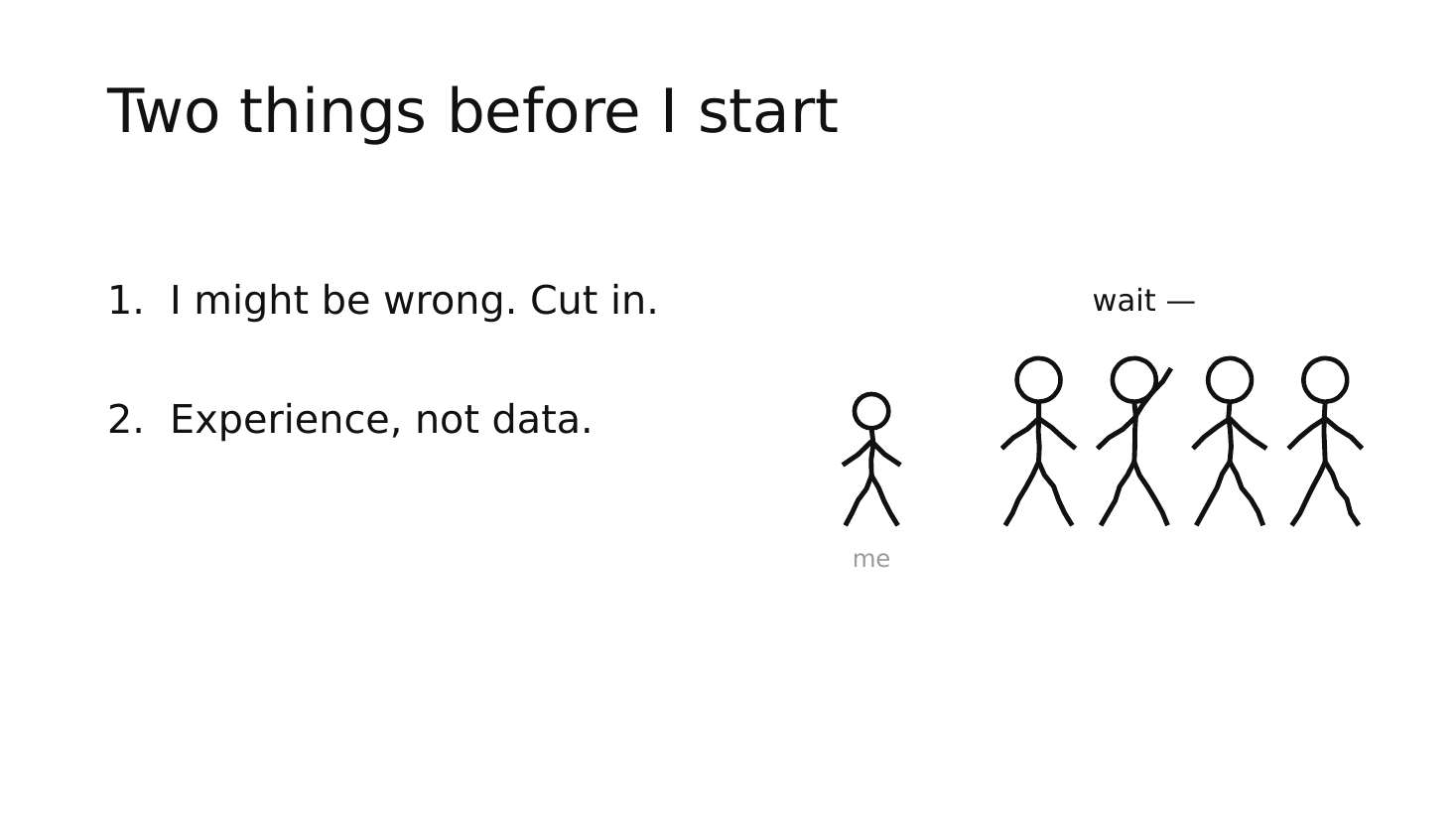
This is a reminder for us. First, I might be wrong. I alwasy told others i am a fool. If something looks stupid, forget it. Second, this is my experience, not data. n = 1. But I can gurantee every words i write is tested by myself for a long time. Hope these can help you. Third, my english is also bad. Some part maybe not native or fluent. So if you feel confused, that's my fault. I will improve my writing during the blogging journey.
Work
Efficiency = shipped ÷ hours
I am efficiceny man, i always try my best to imporve my work efficiency. But question is: what does efficiency mean in the AI era?
in early months of the year, The "token maximum" trend became popular in Silicon Valley and big name company (2). Everyone competed on the token count. I was confused on this...Luckily, they realized how dumb this is at evaluating a person's working efficency(3). The reason is simple, tokens consumed are not equal to things shipped. Also, this doesn't count the hours we spent at the desk. Given this, i made a stupid definition about "efficiency ":
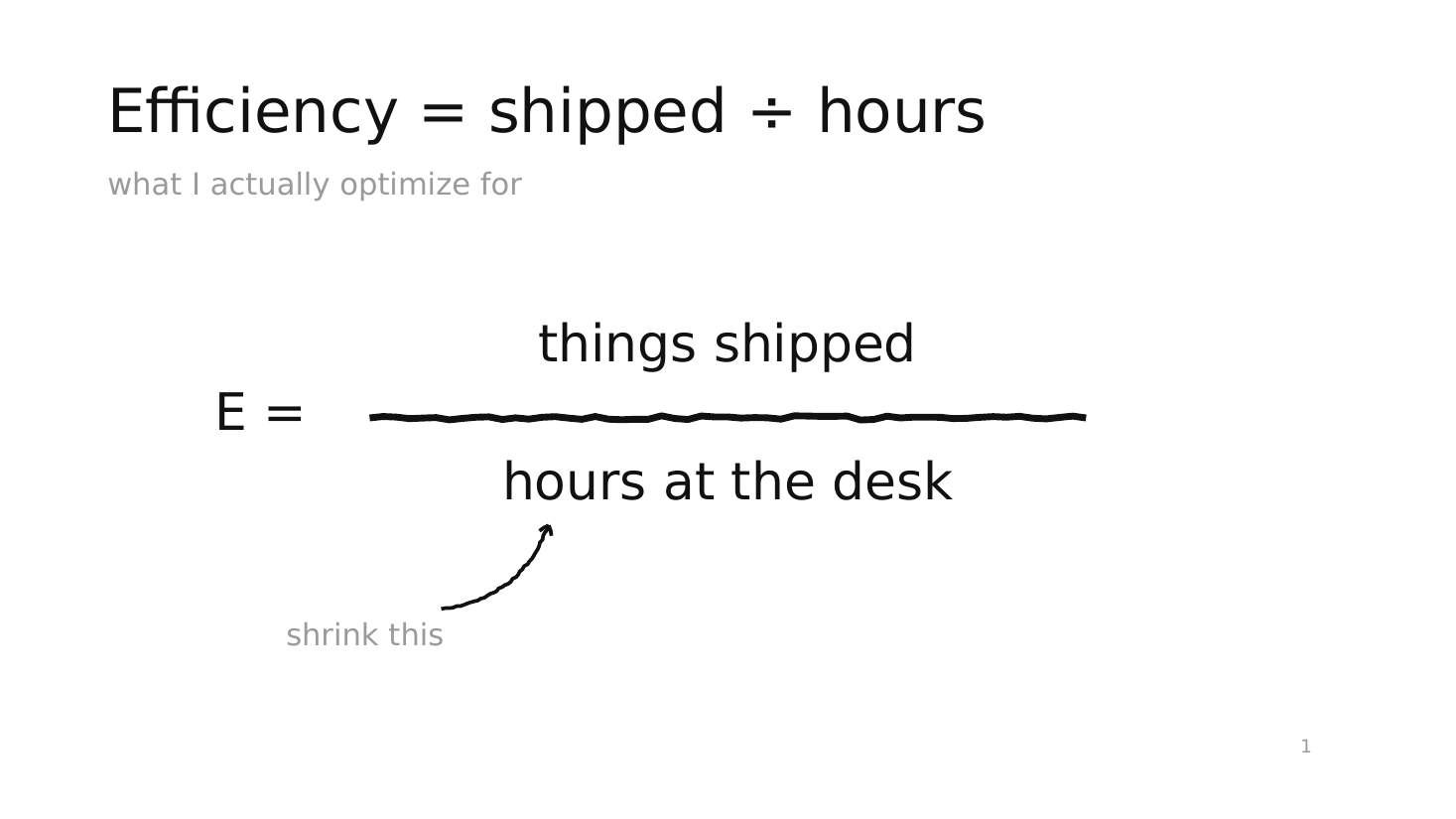
simple but effective for me to guide me for improving the AI efficiency. Now what i need to do is maximum the things that actually shipped within the limited time (because i dont want to sit at the desk all day... i need time, to think, meditate, go to the gym).
Let it run
Imagine a company boss who is skepetical and usually check whether his employees work correctly, do you think this is a good boss? Chances are that he will be tired and the employees efficency and creativity will be constrained (here a "stupid" illustration is good).
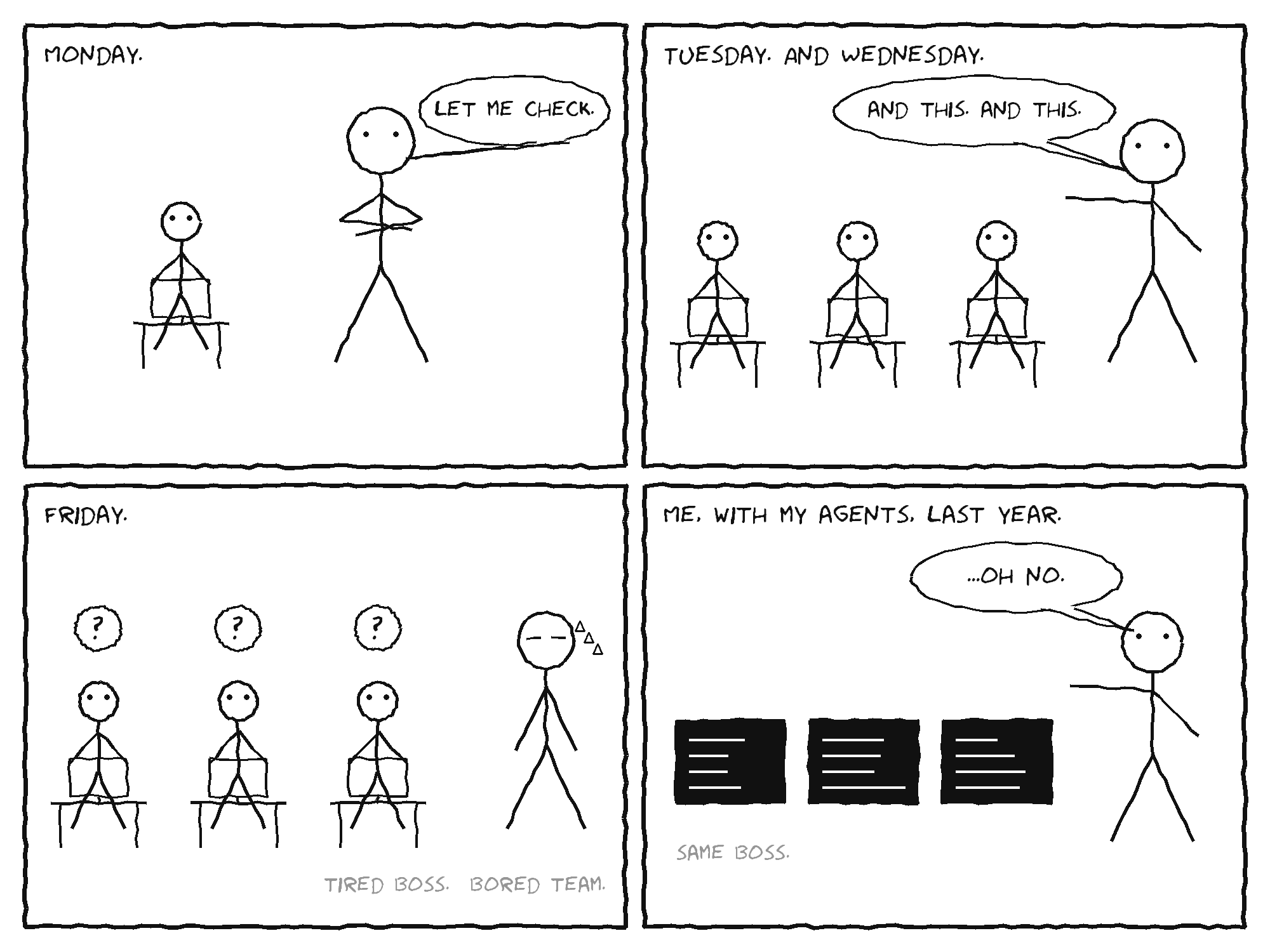
Same in AI use scenario. Unfortunately, i never have been a boss before and didn't understand this till i feel exhausted one day. I remembered i checked the every spec before action and every code after action. This seems crazy today.
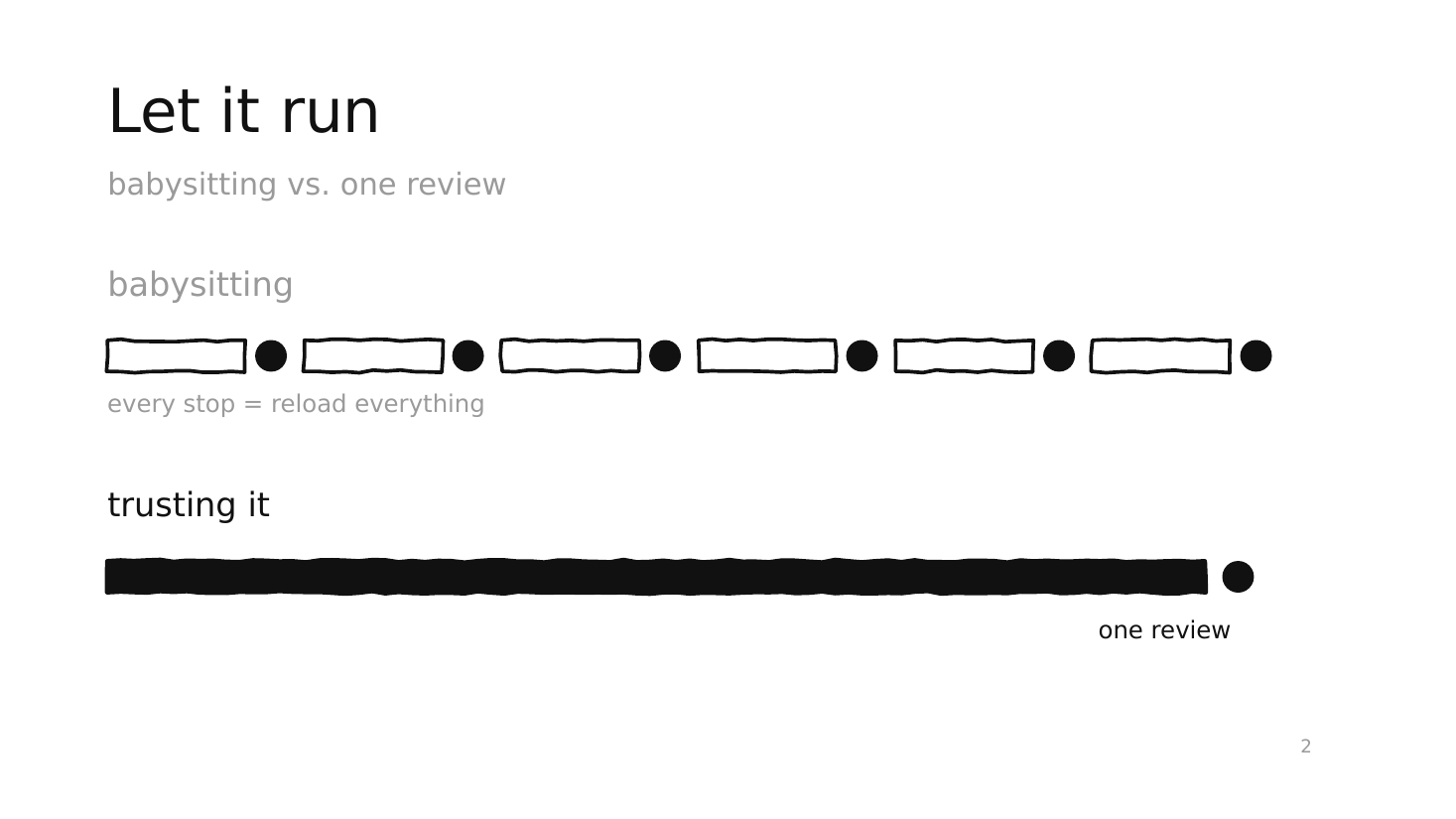
So the core principle is to give AI freedom to run, even though it may make mistakes from time to time (in controlbility part, i will discuss my principles for alleviating the risk). I gave two my commonly used workflow trick as examples.
First, i prefer "graph loop". Although I never know what other implies when they talk about this buzzword, it is just a simple todolist manager for me. I can let the agents plan its execution plan as graph, and sent this to context each turn so that agents know where they are and alleivate long-time caused drift. Second, i prefer automation anything using AI. For example, , rencently, i am developing a tiny translation app yiyi to learn english (projects:https://misterbrookt.github.io/yiyi/). I hope i can stay in the terminal and dont want to do smoke test by clicking ui. So I let my agents write cli(s) to driven ui, record the whole process and show me the video for review.. Emm, I feel like a real boss during the time.
Protect my attention
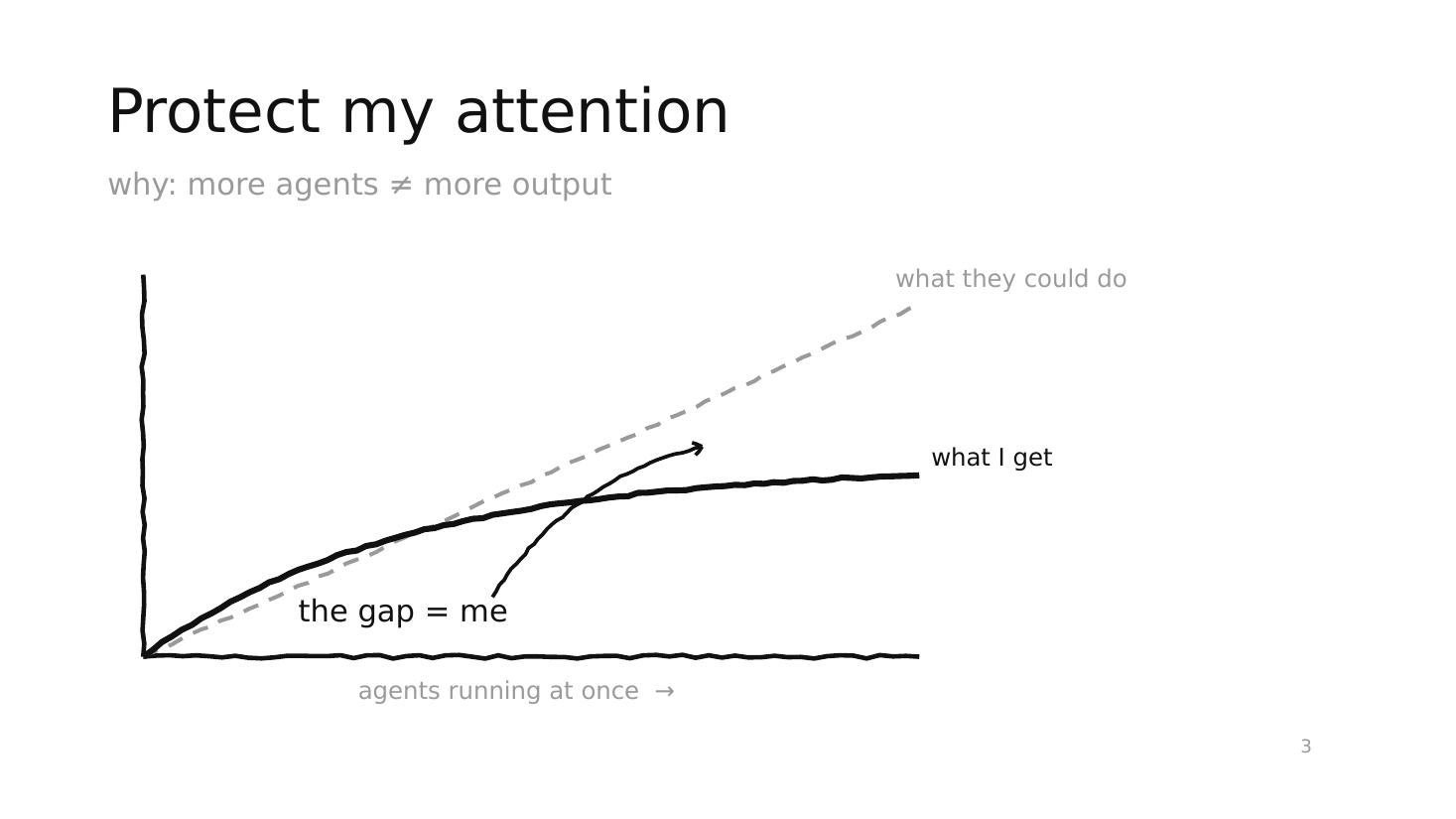
So if one agent can run long, why not run ten? I tried. It does not work. The agents can do more and more, but I can not watch more and more. After two or three, the line goes flat. The gap between what they could do and what I actually get, that gap is me.
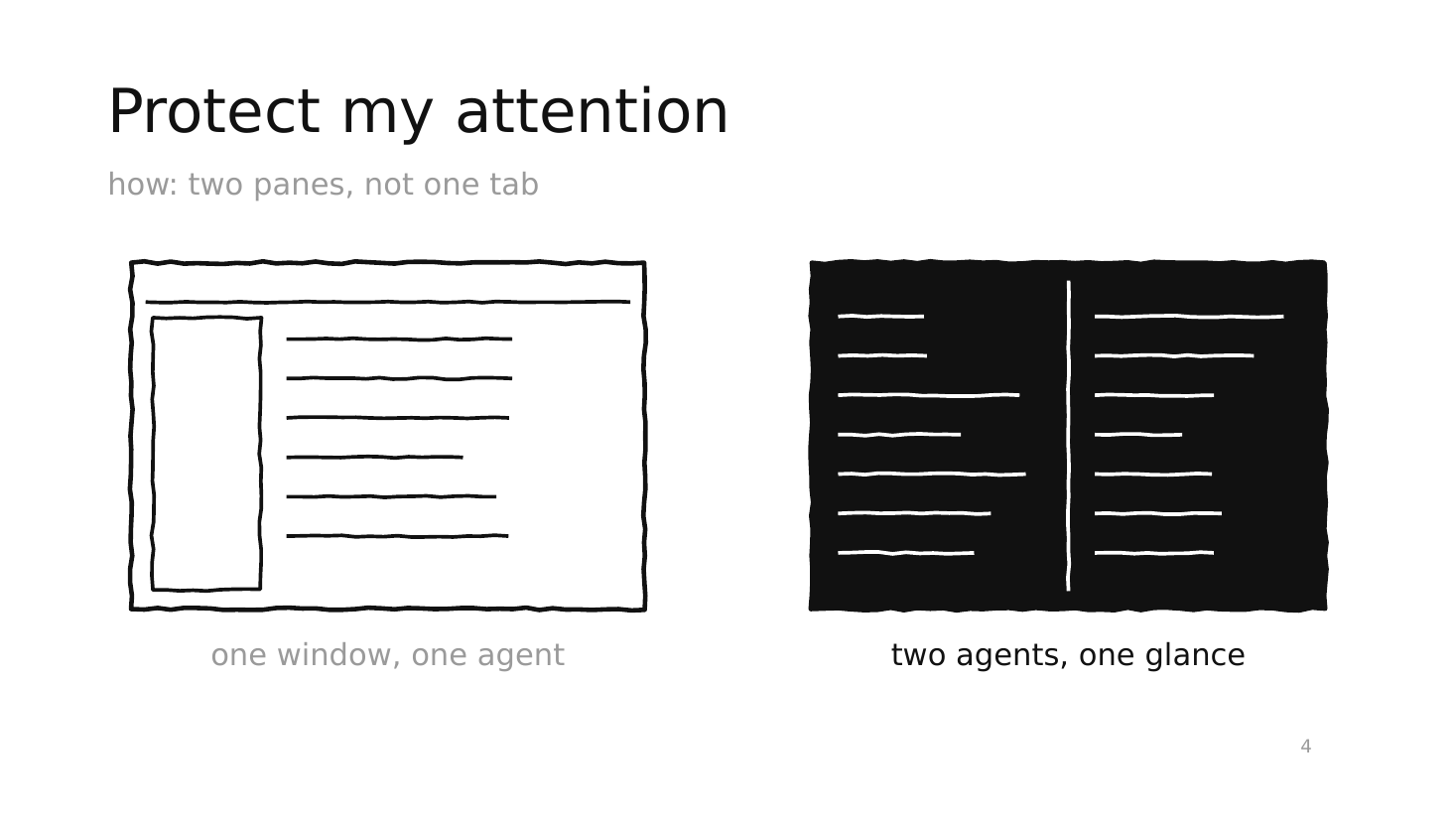
After I delegate the agent some tasks, the "empty" feeling comes to me. I remember there is some tweet discussing what we can do at the agents' working time, but i am too lazy to find and cite it. I watch the guys around me. They tend to scroll their phone and hope agents can deliver a good result for them. This sounds good, "boss-like" feeling. But this is worst for me: frequent context switching always exhauste my energy. So one alternative is to launch more agents to minimalize the idle time. But even this setting, current ADE like codex or claude desktop needs you to open a new tab. This still makes me tired.
So, cozy setting for me is some old-school programming setup: terminal with split. with this, i can always see two agents in a screen. (My favor is otty(4) +pi(5)). I do can launch four, or even more agents at a time, but in the long rong, keep it in check is rly important for saving my attention.
Context is expensive
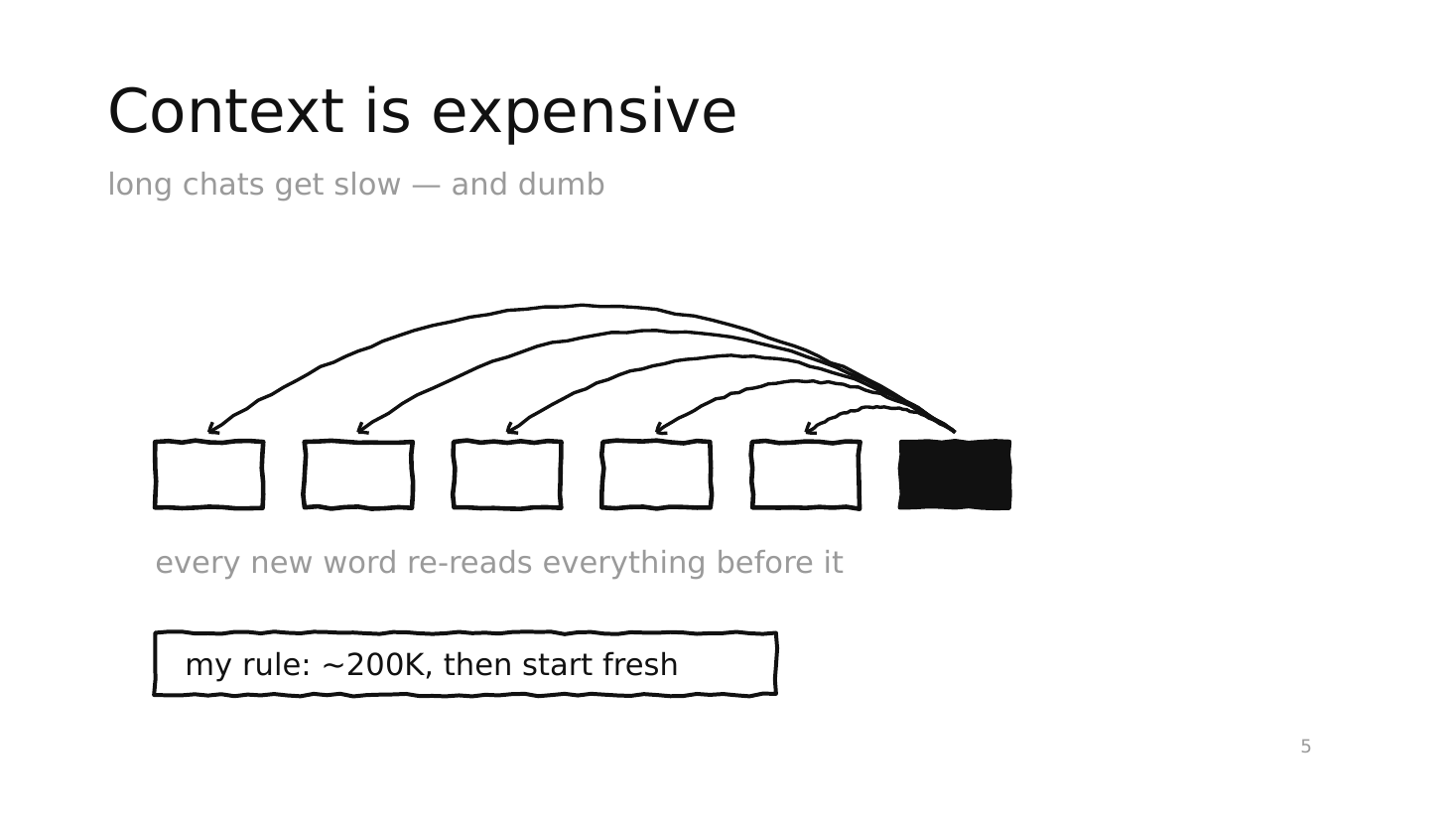
So my rule is simple: around 200K, then I start a fresh one. Not a magic number. It is derived from benchmarks (7, 8). A sweet point for balancing the model performance, cost and speed.
Steer with taste
Before, my AGENTS.md was full of reminders. "remember to write the docs." "don't forget the tests again." It grow and grow. But the agent reads the whole file, every turn. And everytime Agents make an effort to cater to my constraint, costing more and constrain its capability (anthropic claude code also cutdown their system prompt (9)). So every line I add, I pay again and again, and the useful lines get lost in the noise.
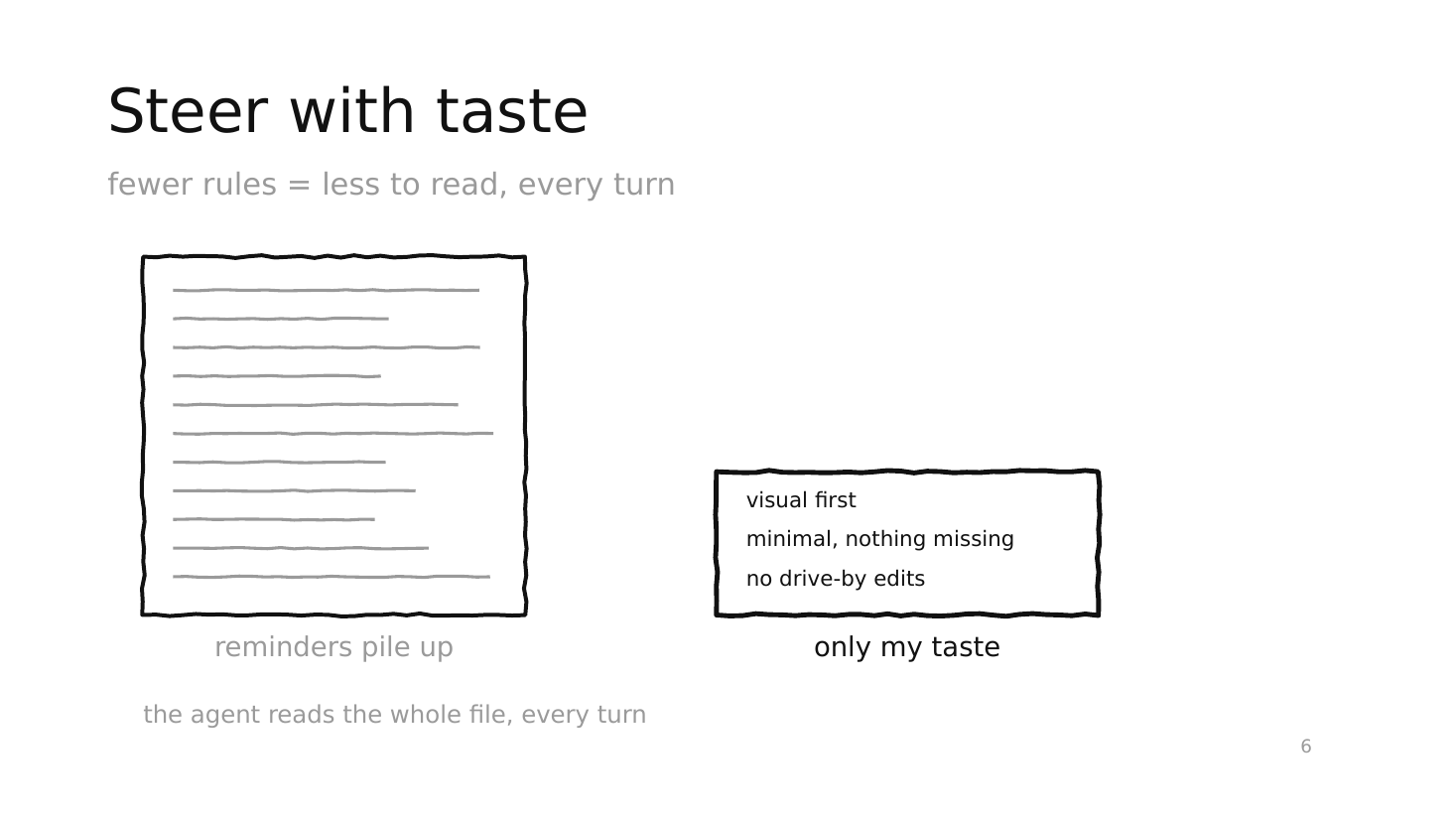
Now I only keep my taste there. I like visual first. I like minimal, but nothing missing. I hate drive-by edits. A few lines, that's all. A preference works on every turn. A reminder works once, then it is just trash sitting in the context.
Pay for the model, not the thinking
My setting: always the best model, always the lowest thinking effort. Many people do the opposite, a cheaper model with max thinking. I think this is wrong. A big model thinking a little is better than a small model thinking hard. And even on the same model, more effort stops helping very fast. On one coding benchmark, medium and high effort got almost the same score, but high used about double the compute (10).
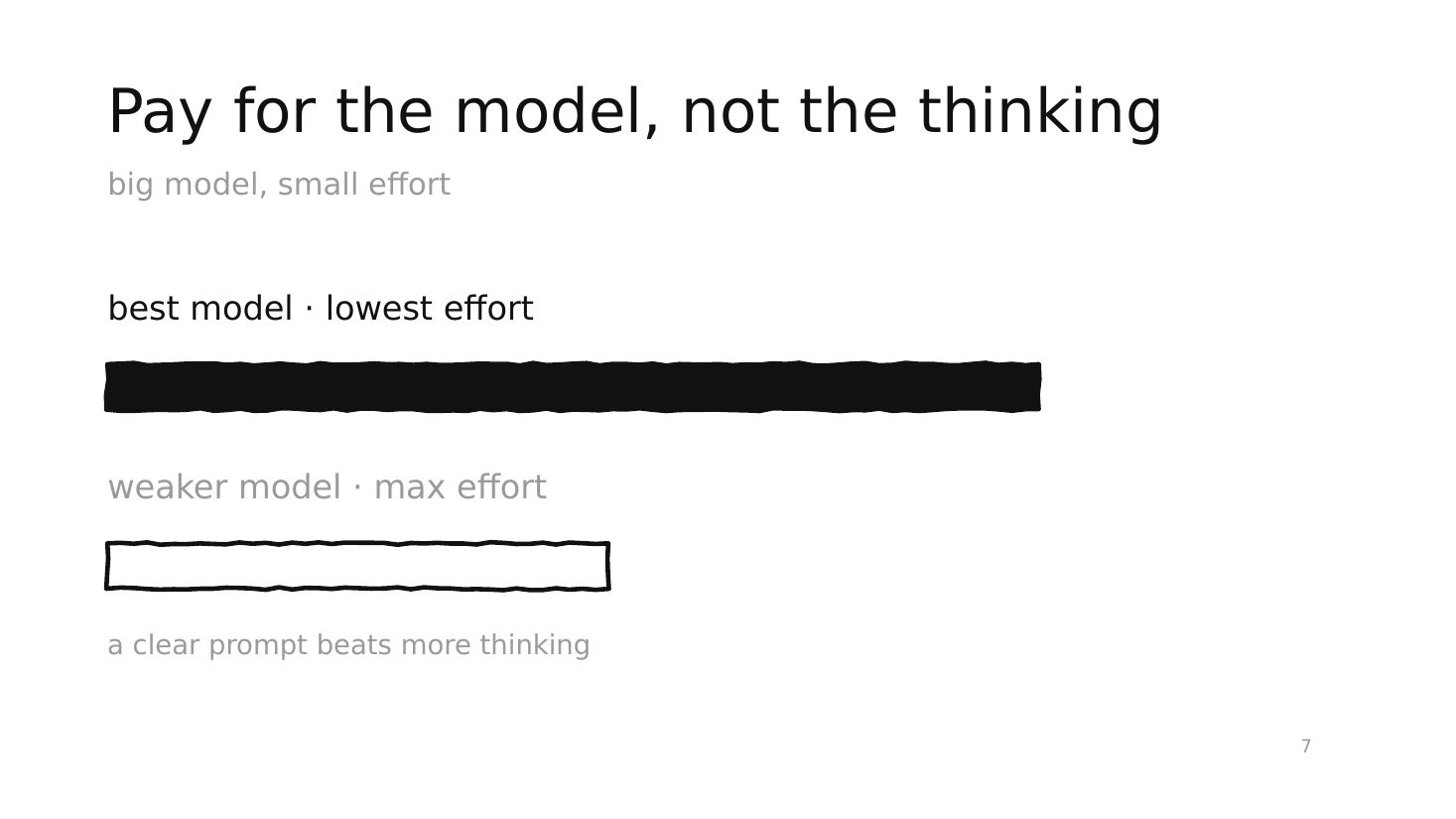
Why do benchmarks say "think more"? Because a benchmark gives the model one fixed prompt and walks away. Thinking is the only thing it can do. But real work is a conversation. I can correct it in five seconds. That is cheaper than any amount of silent thinking. If my prompt is clear, extra thinking mostly finds new ways to overcomplicate the right answer.
Anyway, this is my long-time personal feeling. Maybe you can try if this is interesting for you.
Trust the execution
Most of us never been a boss as i said before. So when the agent makes a mistake, we get angry. But let me count honestly. How many mistakes did the agent make today? Three, five maybe. How many did I make? Emm... dont get up early, say some inapproarate words to my colleague....many more.
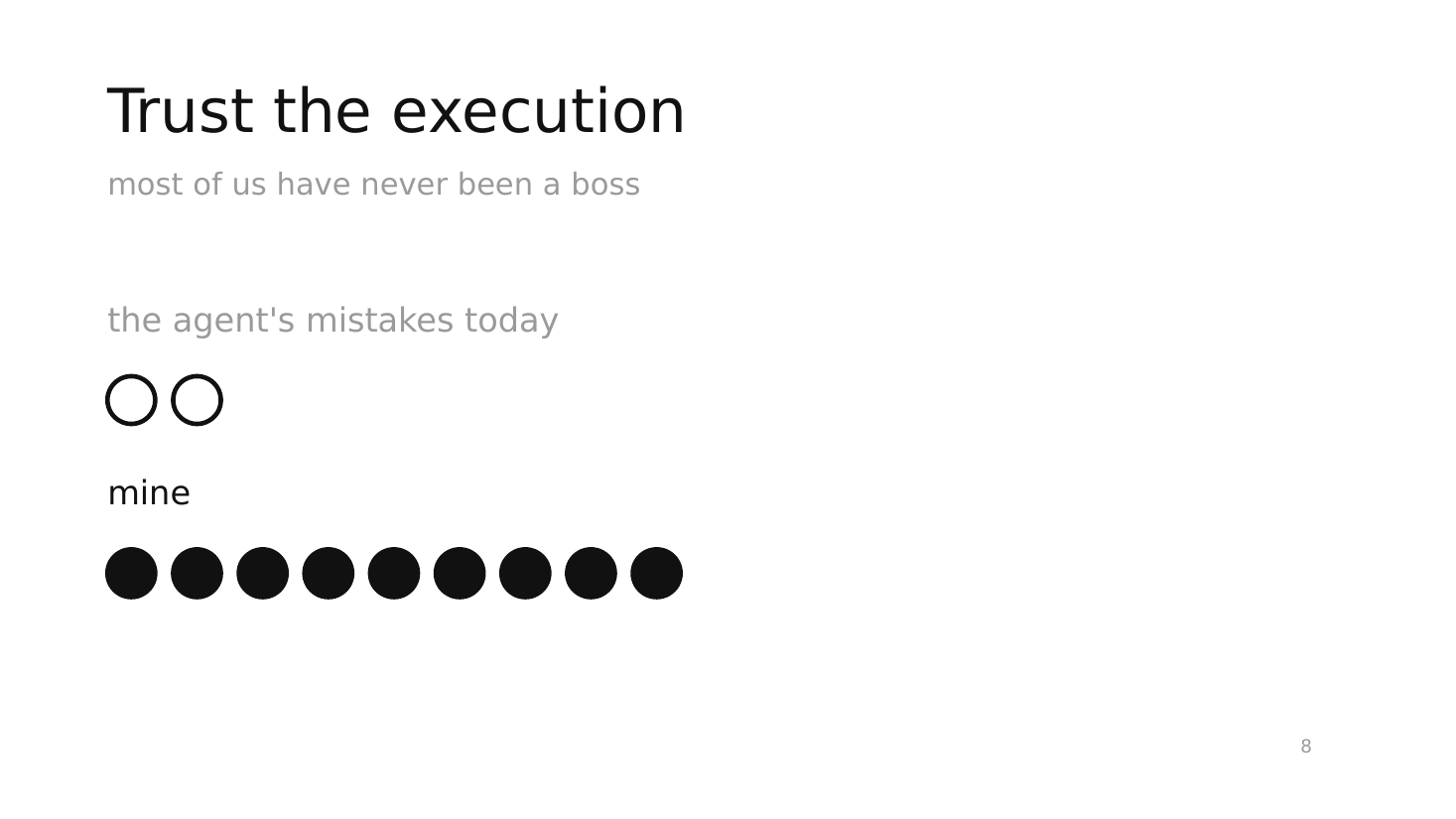
I was angry at a machine for being as fallible as me. That is kind of funny.
Make it hard to lose
Trust does not mean no control. It means putting control in the right place. I think about it like a ladder. At the bottom, a rule in my head, or a rule written in a file. The agent can drop those anytime, different model, long context, whatever. Higher up, a linter, a test. Those can not be dropped. The build just goes red.
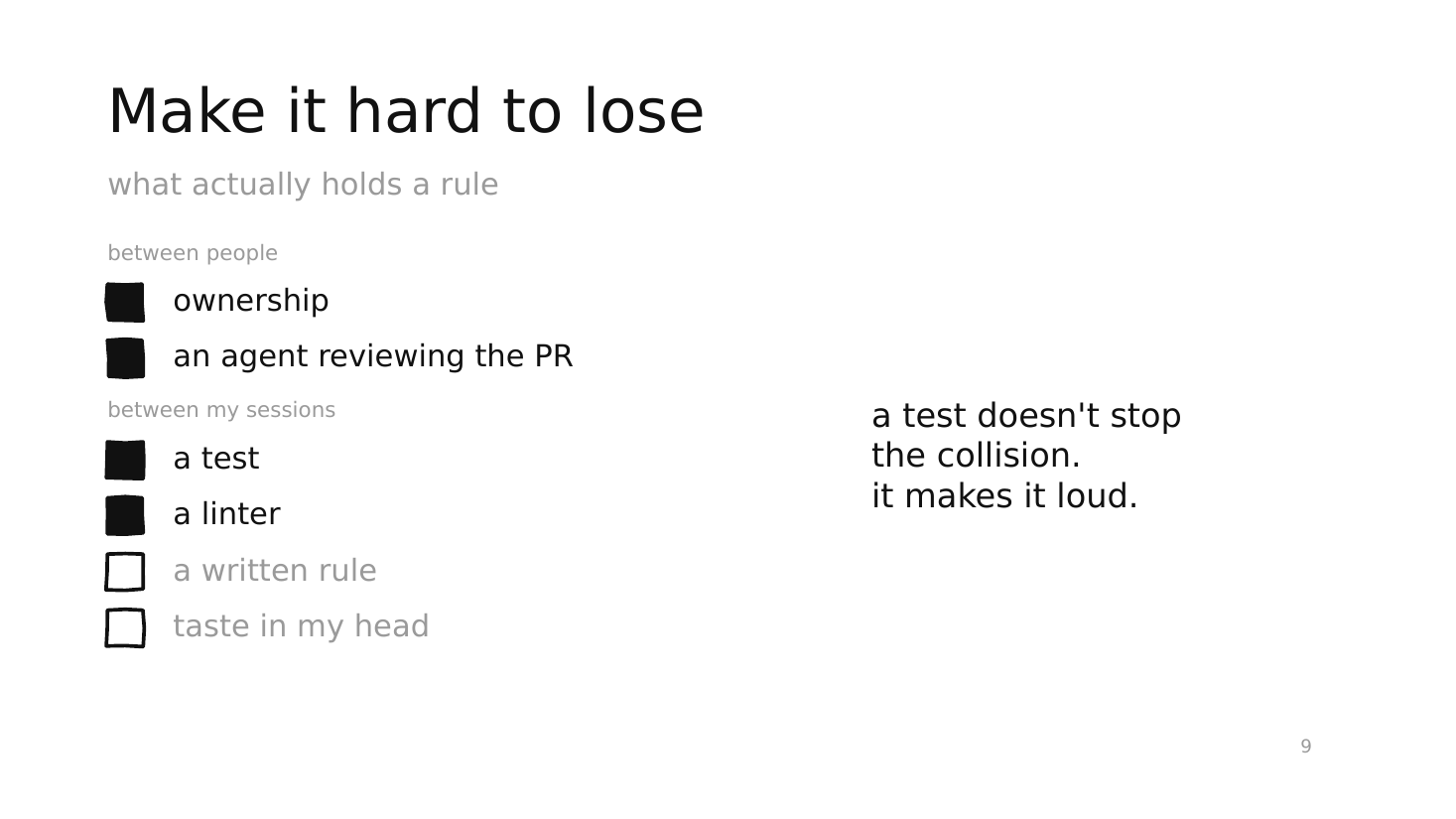
This is from a real week on my team. One design decision lived in ten files. Several people and their agents touched it at the same time. It quietly went back to an old version, and nobody noticed for days. A test would not stop that collision. But it would make it loud, in ten minutes instead of three days. So now I think: when you make a decision, write the test at the same time.
And the top two steps are not for me alone, they are for a team: an agent that reviews every PR and pings the owner, and one clear owner for each part. Tools can not replace that.
Life

Personalized
A good teacher can not teach every student the same way. But that is exactly what most courses do. Chapter 1, chapter 2, 100 new words a day, same for everyone.
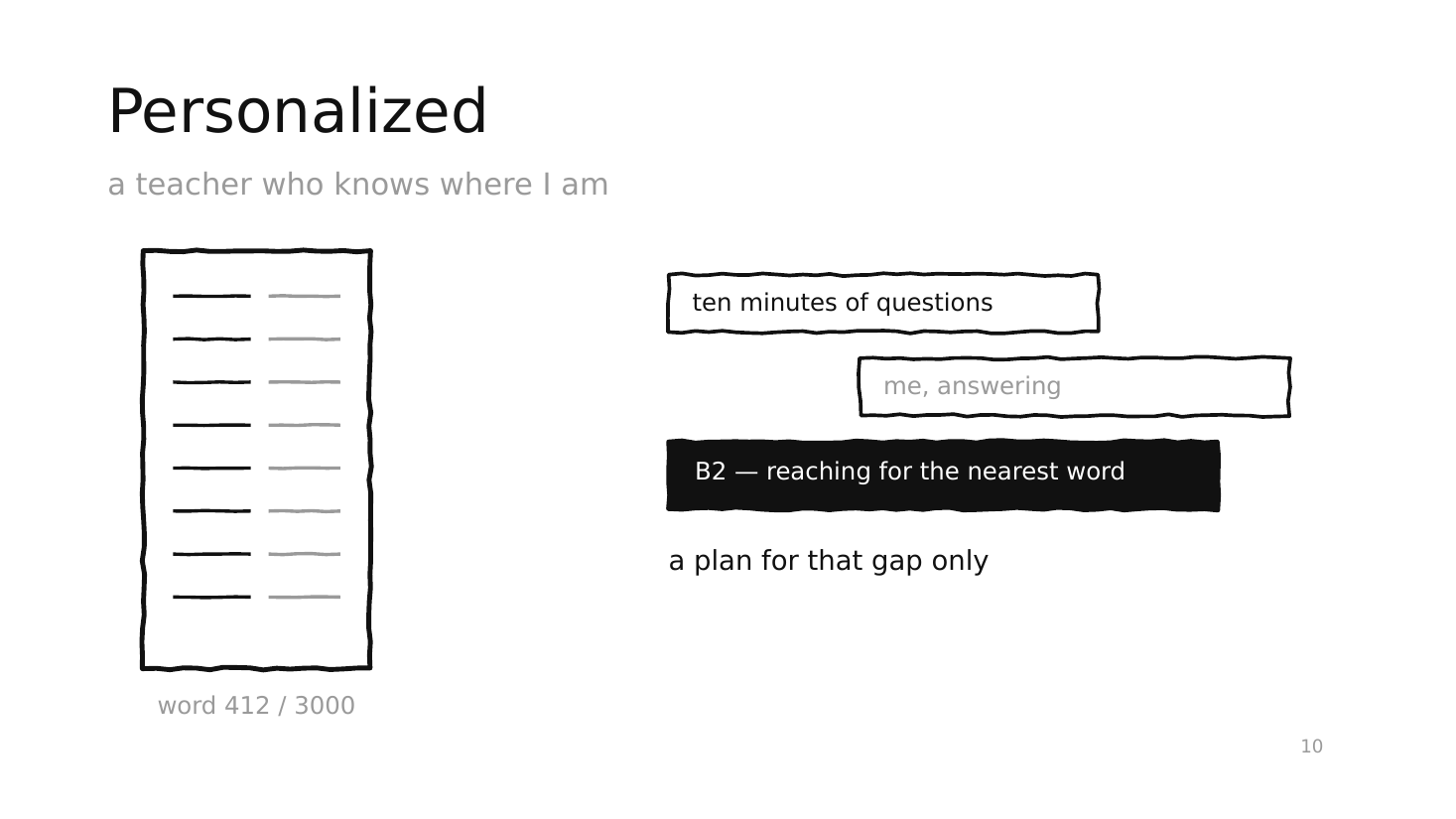
So I let the AI grill-me first(a good skill here: matt pocoke grill me(11)). After ten minutes it told me: you are B2. You can argue a complex opinion in English, you just reach for the nearest word, not the native one. I could never say this about myself so clearly. Then it made a plan only for that gap.
Same for the gym. I have a bit of round shoulders, and honestly I don't want to go to the gym. So it told me: buy two dumbbells, train in your dorm, twenty minutes. And it gives me a plan week by week. And when I started learning finance for my job, sharpe ratio, leverage, all new for me, I gave it real code from my work and this week's news, and let it teach me from those. Much better than a textbook.
A higher floor
In real life, maybe 100 opinions reach me every day. Maybe one is worth acting on. The rest is noise. Especially the people near you. They are not bad people, they just have one life of data, and one bias.
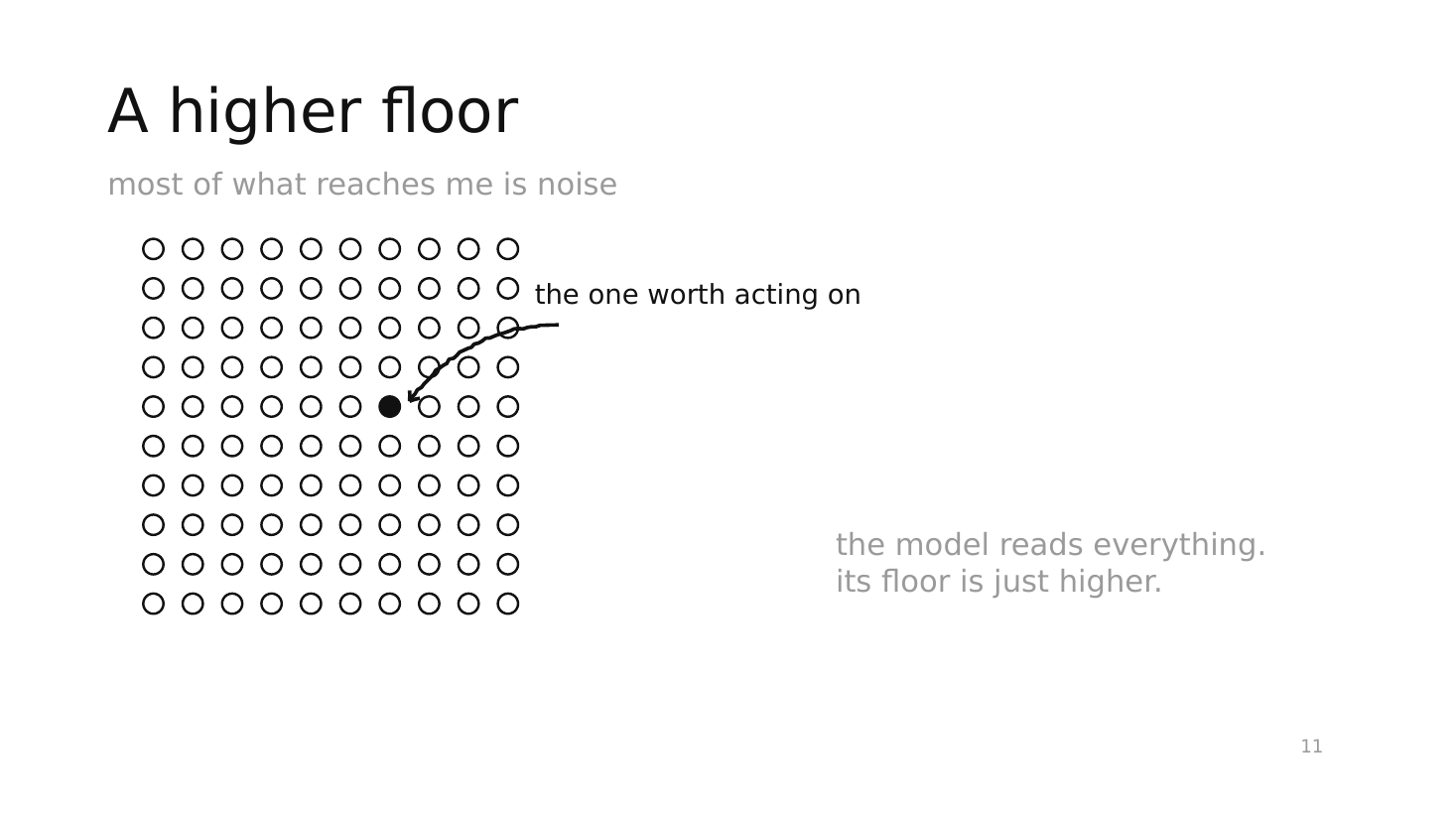
The model is different. It read almost everything people wrote down, including the small part that is really good. That doesn't make it wise. It just makes its floor higher than the room I am standing in. For me, asking the model is maybe 80 out of 100. And for the old questions, like what to do with a feeling, what is worth wanting, the best is the model plus a really old book. The model finds the book. The book still does the work.
Philosophy
Keep updating
In 2024, I wrote the plan and the model typed. In 2025, I wrote the rules and it made the plan. Now I mostly just say what good looks like. Same job. The split keeps moving.
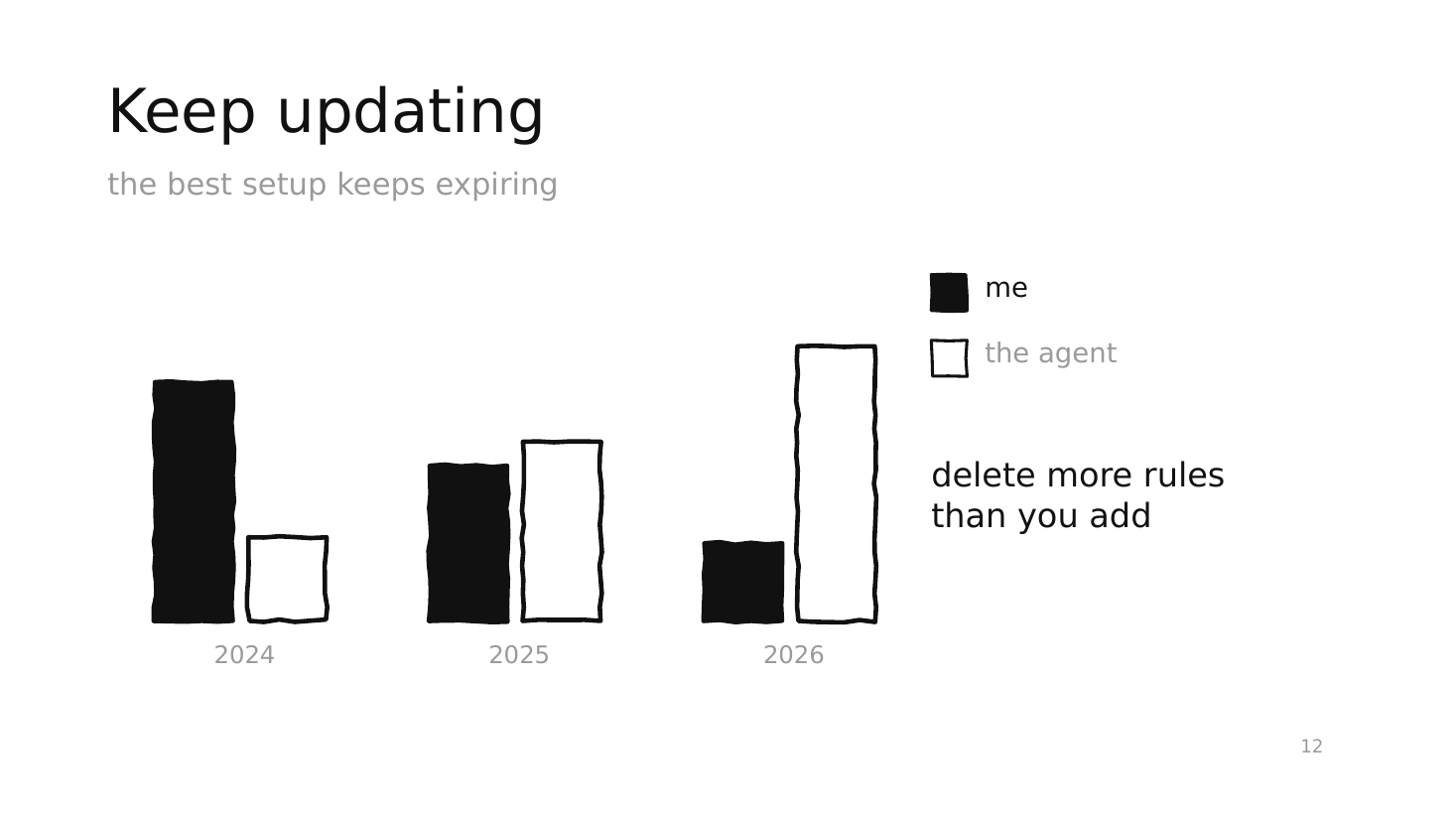
So the best setup keeps expiring. A rule that was good guidance six months ago is a leash today. My habit now: read my own rules every week, and delete more than I add.
The moat is human
I also have to admit, I overrate AI in the short term. Even Sam Altman said he was "too ambitious" about the timeline (12). AI is really good, but it lives only in the digital world. Code that nobody trusts, and nobody hears about, ships nothing.
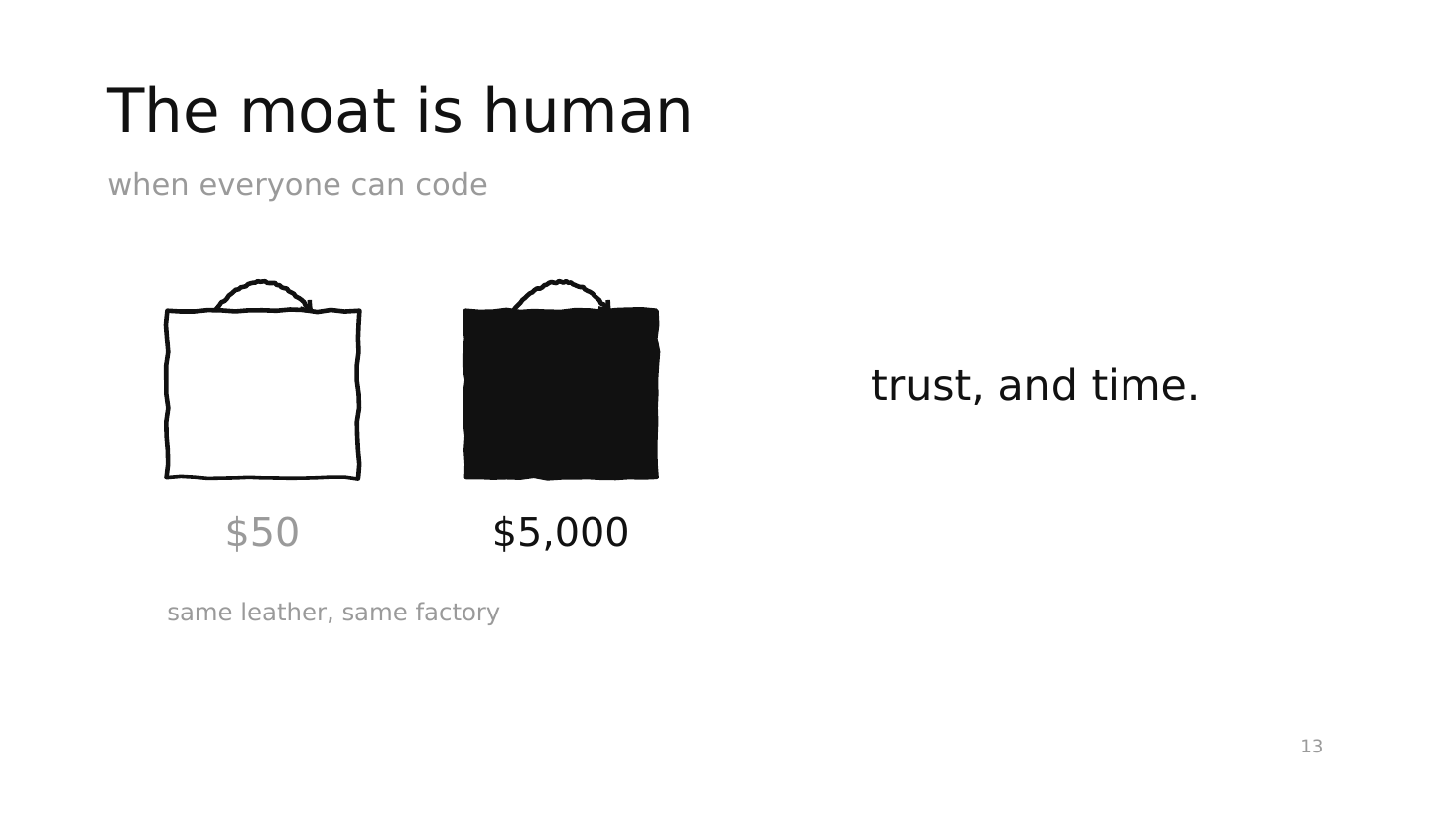
A Chanel bag and a normal bag can use the same leather, maybe even the same factory. One is 100 times more expensive. The gap is the story, the trust. When everyone can code, I think this is where compounding comes from. Stay in one place long enough, keep making things, let people know you and believe you. Trust, and time.
Cozily, for me
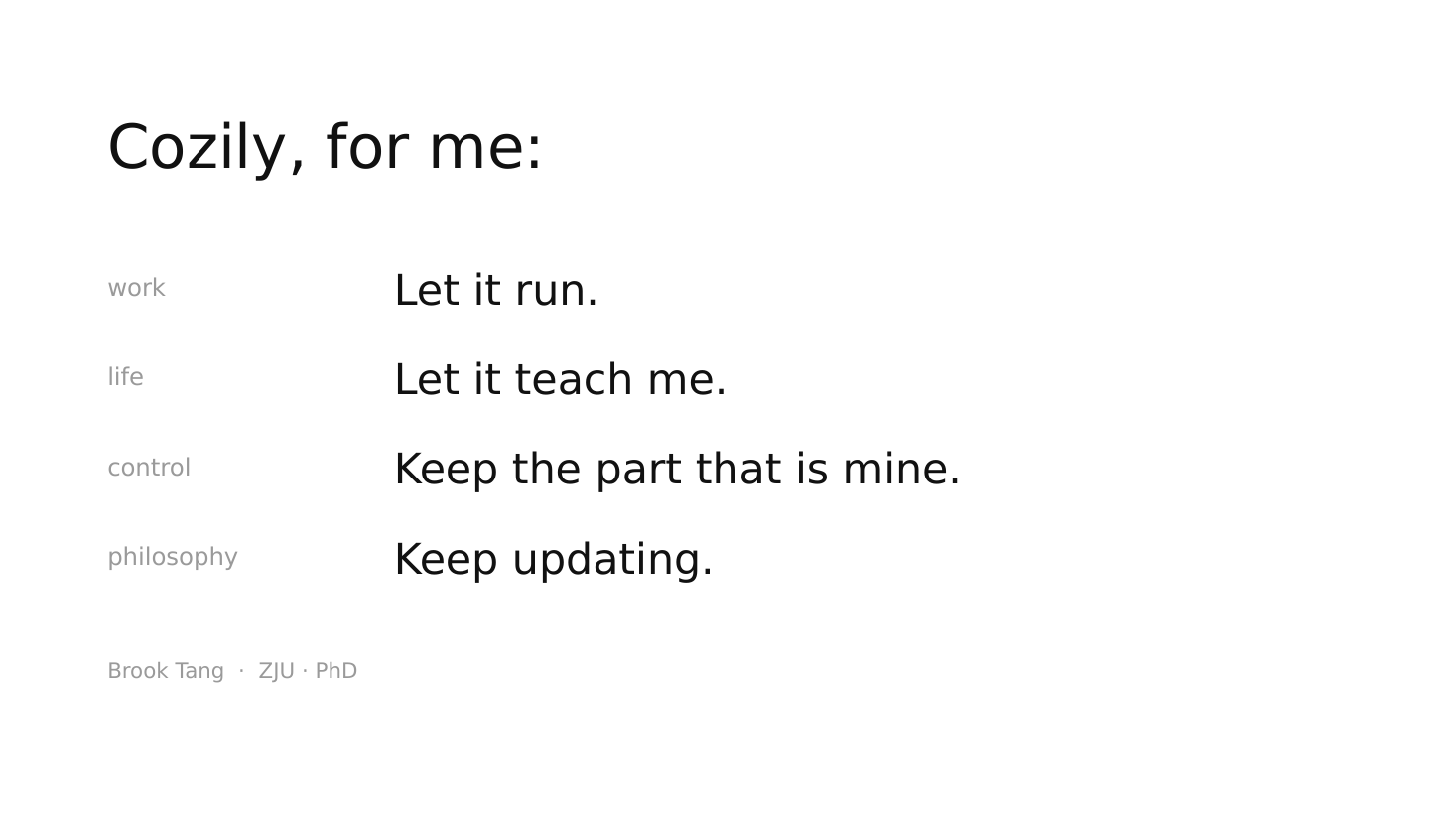
- work: let it run.
- life: let it teach me.
- control: keep the part that is mine.
- philosophy: keep updating.
That's all. Thanks for reading my first English blog. If something is wrong, tell me, I really want to know.
Love.
References
- Nassim Nicholas Taleb, Fooled by Randomness (2001)
- The Pragmatic Engineer, "'Tokenmaxxing' as a weird new trend" — https://blog.pragmaticengineer.com/the-pulse-tokenmaxxing-as-a-weird-new-trend/
- Fortune, "A Meta employee created a dashboard so coworkers can compete to be the company's No. 1 AI token user" — https://fortune.com/2026/04/09/meta-killed-employee-ai-token-dashboard/
- Otty terminal — https://otty.sh/
- pi coding agent — https://github.com/badlogic/pi-mono
- Chroma Research, "Context Rot: How Increasing Input Tokens Impacts LLM Performance" (2025) — https://www.trychroma.com/research/context-rot
- "LLM Context Windows 2026: Real Accuracy Past 200K Tokens" — https://ofox.ai/blog/long-context-llm-benchmarks-200k-tokens-2026/
- Hsieh et al., "RULER: What's the Real Context Size of Your Long-Context Language Models?" — https://arxiv.org/abs/2404.06654
- The Decoder, "Anthropic says it cut 80 percent of Claude Code's system prompt" — https://the-decoder.com/anthropic-says-it-cut-80-percent-of-claude-codes-system-prompt-because-fable-5-models-want-a-smaller-system-prompt/
- SitePoint, "Claude Opus 5 Is Most Efficient at Medium Effort: FrontierCode Benchmark Data Explained" — https://www.sitepoint.com/claude-opus-5-medium-effort-frontiercode-benchmark/
- Matt Pocock, grill-me skill — https://github.com/mattpocock/skills/tree/main/skills/productivity/grill-me
- Moneywise, "Sam Altman admits he was 'too ambitious' about AI's progress timeline" — https://moneywise.com/news/top-stories/sam-altman-ai-progress-timeline-too-ambitious